Fire Calculation Methods
Fire mapping answers a fundamental question at every mapping point: would a fire detector detect a fire at this location?
Kryptos supports three fire calculation methods: Point, Fire Area (Fixed) and Fire Area (Varying). The methods differ in how a fire is detected and, for the fire-area methods, how much of the fire must be visible to a detector for it to be considered as detected.
The choice of method affects the resulting fire detection coverage and should reflect the project's safety philosophy and fire detection requirements.
WARNING
The calculation method is configured separately for each area under Fire Detection Method in Area Settings. Changing the method or any of its associated parameters recalculates all fire configurations in that area.
Point
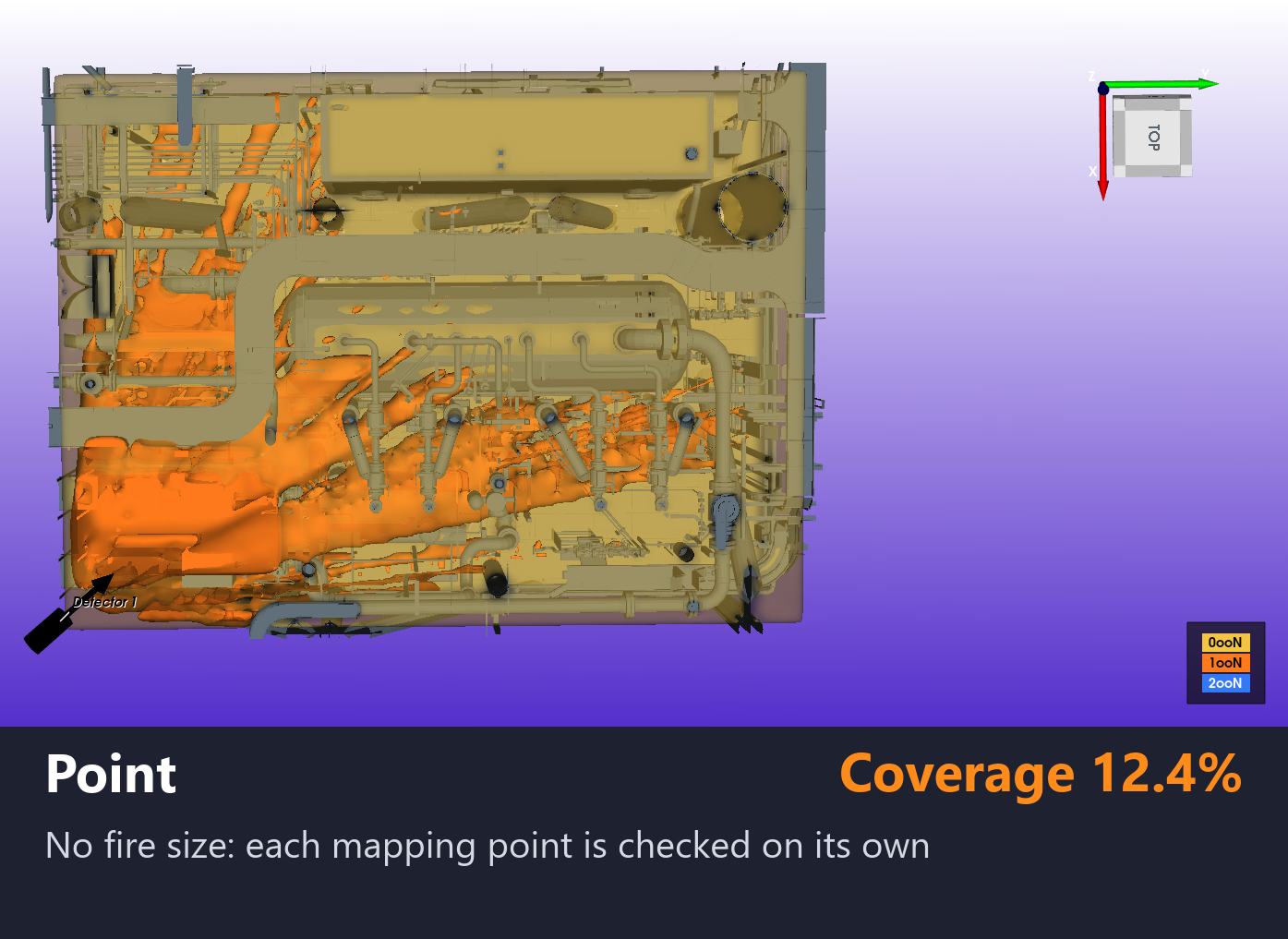
The Point method determines geographical coverage by dividing the volume of the Risk Grade into a set of closely spaced mapping points. These points represent locations at which coverage is evaluated; they do not represent the size or shape of a fire.
Kryptos evaluates points within the Risk Grade that lie outside the 3D plant geometry. The spacing between points is 0.1m along the X and Y axes and 0.25m along the vertical Z axis.
At each mapping point, Kryptos determines whether a detector can see the point by direct line of sight and whether it lies within the detector's detection range for the corresponding Risk Grade.
A point is considered covered only when both these conditions are satisfied. Otherwise, it is not covered by that detector. There is no partial coverage at an individual point.
The overall fire detection coverage is simply the percentage proportion of eligible mapping points covered by the detectors of the relevant detector configuration.
Characteristics
- Fire representation: A single point, with no defined fire dimensions.
- Visibility requirement: The mapping point must be visible to the detector.
- Detection range: The point must lie within the applicable detector range.
The Point method is useful when the assessment is intended to determine geographical coverage without explicitly modelling a fire of finite dimensions.
Fire Area (Fixed)
The Fire Area (Fixed) method accounts for the finite dimensions of a fire being visible to the detector rather than treating instead of treating each individual point independently for detection.
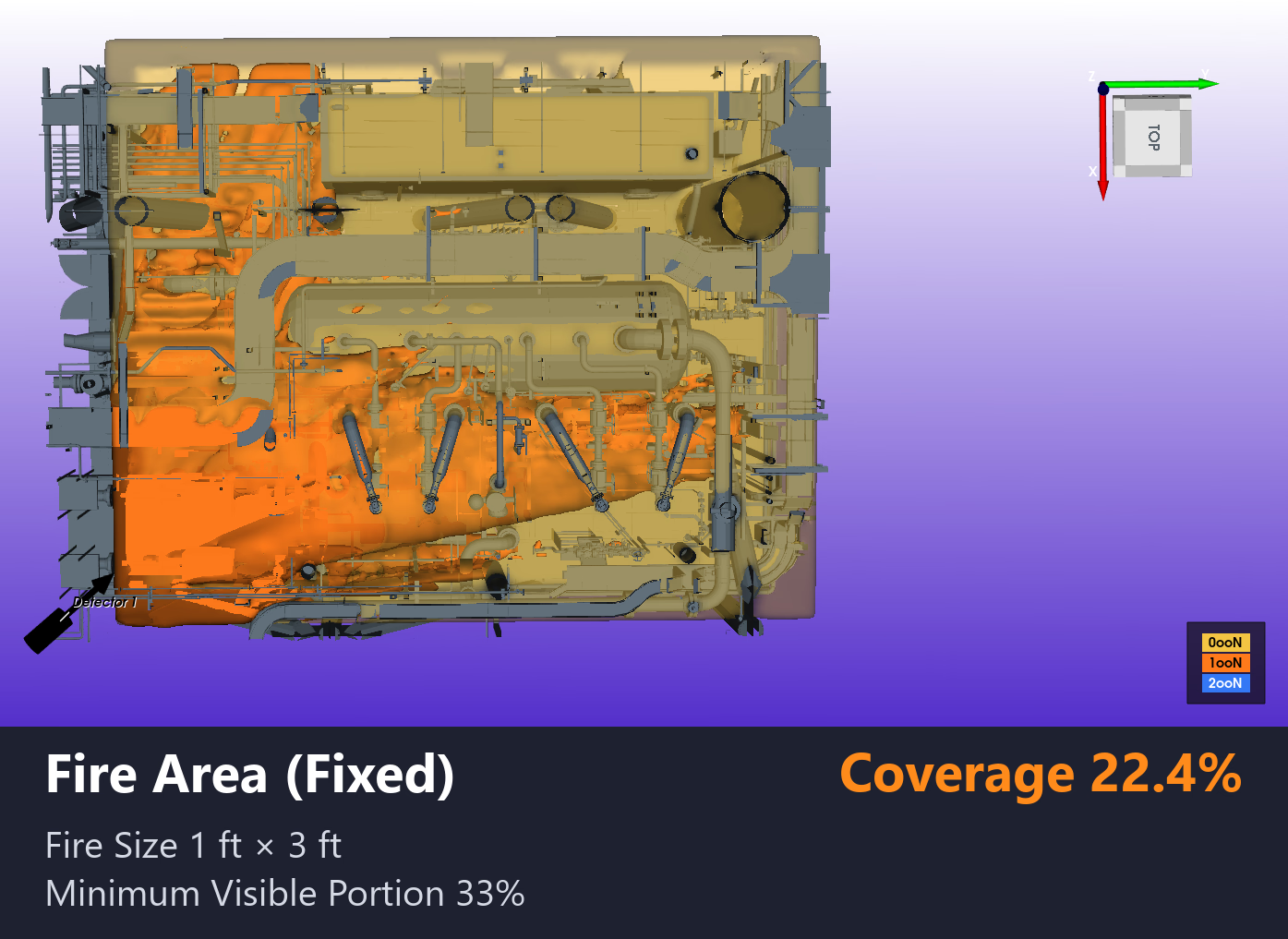
At every mapping point, Kryptos evaluates a rectangular fire area defined by Fire Size, specified in terms of width and height. The detector must see a sufficient proportion of this area for the fire to be considered detected.
The required visible proportion is specified by Minimum Visible Portion (%). Unlike the varying method, this requirement remains constant regardless of the distance between the fire and the detector.
For example, if the required visible portion is set to 100%, the entire defined fire area must be visible to the detector. If it is set to 50%, at least half of the fire area must be visible, subject to the detector's detection range and other applicable detection criteria.
Characteristics
- Fire representation: A rectangular fire area with a defined width and height.
- Visibility requirement: A specified proportion of the fire area must be visible for successful detection.
- Distance dependency: The required visible proportion remains constant at all distances. A fire close to the detector and a fire far away (assuming both are within the detector's range) will need to have the same required visible proportion (%) of the fire area to be detected for the respective fire to be considered as detected.
- Detection range: The fire must still be within the detector's applicable detection range.
The fixed method is appropriate when the project's safety philosophy specifies a constant visibility requirement for the fire size being assessed.
TIP
The required visible proportion should be selected in accordance with the project's fire detection philosophy. A requirement of 100% is more restrictive with respect to obstruction than a lower percentage, which permits part of the defined fire area to be obscured.
Fire Area (Varying)
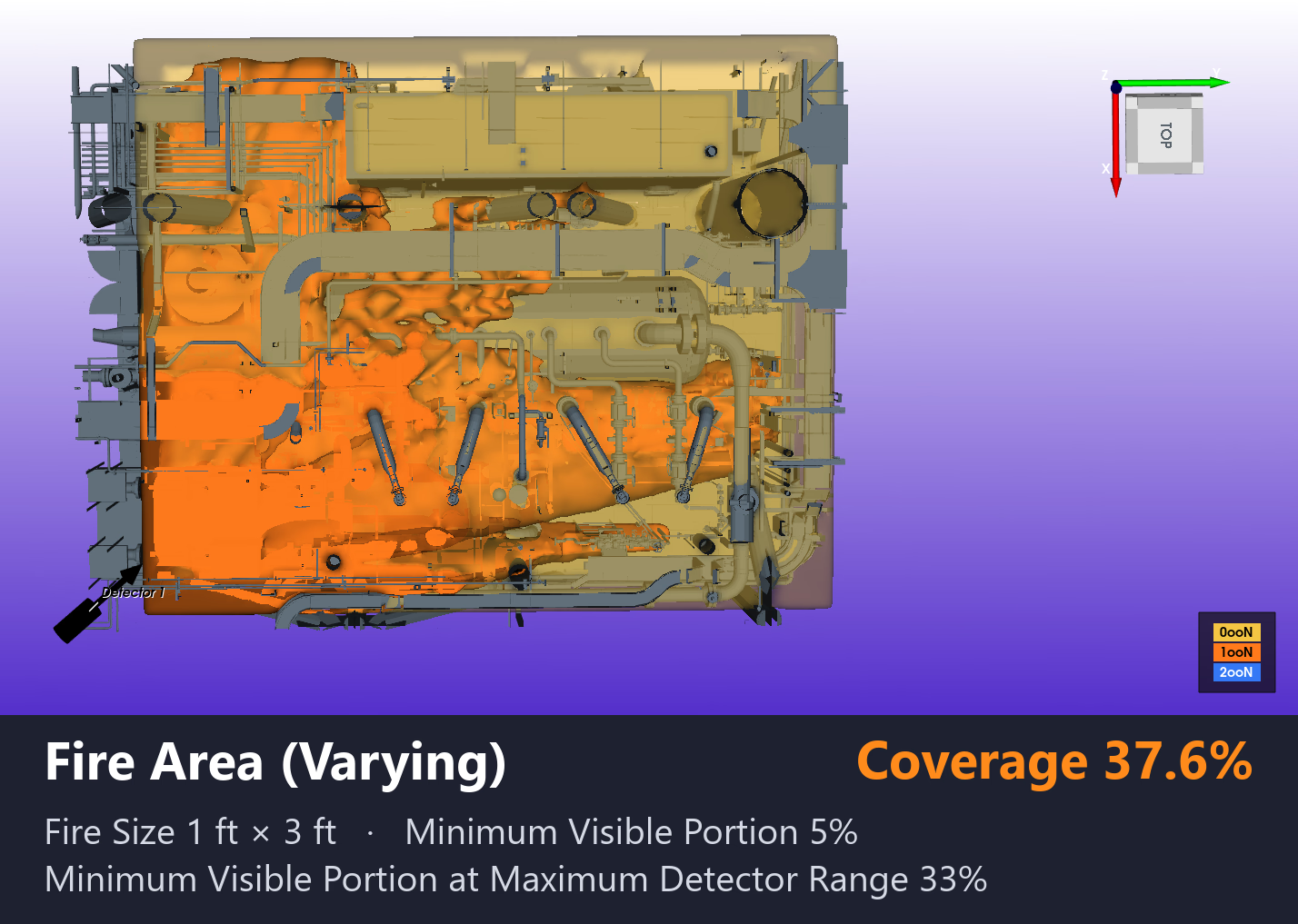
The Fire Area (Varying) method also represents a fire as a rectangle with a defined width and height. However, unlike the fixed method, the proportion of the fire area that must be visible to the detector varies with the distance between the fire and the detector.
This method accounts for the inverse-square relationship between detector distance and received radiation intensity. As the distance between a fire and a detector decreases, the radiation received from the fire increases. Consequently, a smaller visible portion of the fire may be sufficient to meet the detection requirement at shorter distances.
The required visible proportion is anchored at the detector's maximum detection range and decreases as the fire gets closer to the detector. Kryptos also applies a user-defined minimum visibility requirement to prevent the required visible proportion from falling below a specified value at short distances.
Parameters
The Fire Area (Varying) method uses the following parameters:
- Fire Size — defines the width and height of the fire area evaluated at each mapping point.
- Minimum Visible Portion (%) at Maximum Detector Range — specifies the minimum proportion of the fire area that must be visible when the fire is at the detector's maximum detection range.
- Minimum Visible Portion (%) — specifies the lower limit for the required visible proportion as the fire gets closer to the detector.
How the Distance-Dependent Requirement Works
The Fire Area (Varying) method uses the inverse-square law to adjust the required visible proportion of the fire according to the distance between the fire and the detector. The requirement is anchored at the detector's maximum detection range and decreases as the fire gets closer.
The calculation follows three principles:
- At maximum detection range, the required visible portion is defined by Minimum Visible Portion (%) at Maximum Detector Range.
- At shorter distances, the required visible portion decreases according to the inverse-square law. For example, at 1/2 (half) the maximum detection range, the calculated requirement is 1/4 (quarter) of the value specified at maximum range, before applying the minimum limit.
- At shorter distances still, the user-defined Minimum Visible Portion (%) acts as a floor. The required visible portion cannot fall below this value, regardless of how close the fire is to the detector.
For example, suppose the following values are configured:
- Minimum Visible Portion (%) at Maximum Detector Range: 100%
- Minimum Visible Portion (%): 25%
- Maximum Detector Range: 40 m
At the maximum range of 40 m, the required visible portion is 100%. At 20 m, half the maximum range, the inverse-square relationship reduces the calculated requirement to 25%. At distances closer than 20 m, the calculated requirement would fall below 25%, so the minimum visibility floor maintains the requirement at 25%.
This ensures that the required visible portion decreases with distance but never falls below the minimum specified by the user.
The visibility requirement and the detection range are separate considerations. Reducing the required visible portion allows a fire to be detected when a greater proportion of its area is obscured, but it does not extend the detector's maximum detection range. A fire outside that range is not considered covered by the detector.
WARNING
Minimum Visible Portion (%) cannot exceed Minimum Visible Portion (%) at Maximum Detector Range.
The varying method reduces the required visible proportion as the fire gets closer to the detector, subject to the minimum visibility limit. Setting the minimum above the value required at maximum range would contradict this relationship, so Kryptos rejects such a value.
TIP
The varying method is useful when the assessment needs to account for the effect of distance on the radiation received by a detector. The maximum-range visibility requirement and minimum visibility limit should be selected in accordance with the project's safety philosophy.
Comparing the Three Methods
| Characteristic | Point | Fire Area (Fixed) | Fire Area (Varying) |
|---|---|---|---|
| Fire representation | A single mapping point | A rectangular fire area | A rectangular fire area |
| Fire dimensions required | No | Yes | Yes |
| Visibility requirement to the Detector | The mapping point must be visible | A specified proportion of the fire area must be visible | A distance-dependent proportion of the fire area must be visible |
| Requirement varies with distance | Not applicable | No | Yes, according to the inverse-square law, subject to a minimum visibility floor |
| Minimum visibility limit | Not applicable | The fixed required visible proportion | Yes |
| Detection range enforced | Yes | Yes | Yes |
The images below show the coverage of the same detector over the same Risk Grade with each method. The method, the coverage and the parameters used are shown under each image.
Selecting a Fire Calculation Method
The choice of calculation method should be based on the project's safety philosophy, the fire detection technology being assessed and the assumptions used in the fire detection study.
- Point evaluates geographical coverage at discrete mapping points without assigning dimensions to the fire.
- Fire Area (Fixed) evaluates a fire of defined dimensions using a constant required visible proportion, irrespective of distance.
- Fire Area (Varying) evaluates a fire of defined dimensions using a distance-dependent visibility requirement, with a specified minimum limit.
These methods represent different approaches to determining fire detection coverage. Results obtained using different methods should not be assumed to be directly equivalent, as the underlying detection criteria differ.
WARNING
Choose the appropriate calculation method and configure its parameters before carrying out detailed fire mapping. Changing the method or its parameters later recalculates all fire configurations in the current area.
Related
- Fire Detectors — understand detector field of view (FOV), curvature, detection range and near-field behaviour.
- Area Settings — configure the fire calculation method and detector models available to an area.